← Back
Fourteen Billion Oysters and Counting

How the Oyster Recovery Partnership rebuilt a Chesapeake fishery, and why every planting vessel now carries a satellite tracker
Oysters are a critical part of the saltwater ecosystem. They clean water, create habitat for other marine species, are a food source, help coastal economies, and they provide a natural layer of protection against coastal storms. Dr. Olivia Caretti, Coastal Restoration Program Manager at the Oyster Recovery Partnership, describes the eastern oyster as unusual on all counts. As a habitat-forming species, it delivers broader ecosystem services while also anchoring a real economy in Maryland, Virginia, and other states along the East and Gulf coasts.
That combination is the reason the Oyster Recovery Partnership exists, and it is why a nonprofit founded to put shell back on the bottom of the Chesapeake now runs an operation that looks a lot like a logistics company with a science department attached.

A fishery crashed, and a thirty-year answer
The Oyster Recovery Partnership, or ORP, is the nonprofit expert in oyster restoration in the Chesapeake Bay, and its mission is to restore the native eastern oyster to a bay where the species was once so abundant that reefs were a navigational hazard. Decades of overfishing, water pollution, and disease took the population down to a fraction of what it had been, and the fishery collapsed along with it. Over the past three decades ORP has planted more than 14 billion oysters in the Chesapeake, and the organization has been working at large scale for close to twenty years now. Sarah Greenberg, Coastal Resource Scientist at ORP, says the results show 98 percent success against the organization’s habitat criteria metrics across every area where large-scale restoration has been carried out.

The partners behind the partnership
ORP is one part of a coalition assembled over thirty years. The oysters themselves begin at the University of Maryland Center for Environmental Science Horn Point Laboratory hatchery in Cambridge, which spawns adult brood stock and produces the larvae. ORP crews fill setting tanks with recycled and aged shell, and the hatchery introduces larvae into those tanks. The larvae swim, settle, and attach, and the result is what the industry calls spat-on-shell.
The Maryland Department of Natural Resources oversees planning, design, and site selection for state restoration work. NOAA, through its Chesapeake Bay Office, funds hatchery production, runs sonar and habitat surveys, and reports annually on progress toward the Chesapeake Bay Watershed Agreement goal of restoring oysters in ten tributaries. The U.S. Army Corps of Engineers Baltimore District has partnered on planning and reef construction. The Chesapeake Bay Foundation, The Nature Conservancy, the Maryland Watermen’s Association, the Virginia Marine Resources Commission, and a long list of academic and local partners fill in around them.
Caretti notes that government agencies and restoration teams build the blueprints behind all of this work over long stretches of time and at considerable cost. This is precisely why tracking each planting and monitoring its success matter so much.

Proving the planting
Once ORP selects a reef site, staff move the loaded setting tanks by forklift onto a conveyor belt, which feeds the shell into large planting vessels. Out on the water, staff gently hose the oysters off the deck onto the reef below.
It is a fast, wet, physical operation, and it has to be accountable to a blueprint drawn by federal and state agencies with public money behind it. Historically, ORP has used GIS and GPS devices on boats to track plantings, while onboard observers ride along and physically confirm that oysters are being placed in the correct locations.
That approach works, but it caps how much work can happen at once. Every vessel needs a person on it, and every person on the water in Chesapeake conditions is an exposure.
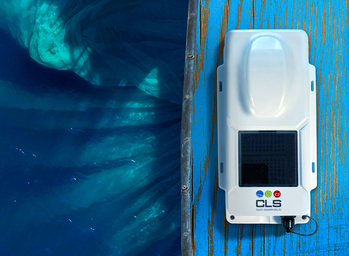
NEMO – VMS powered restoration
This is where NEMO comes in. NEMO is an all-in-one vessel monitoring system (VMS) developed by CLS and supported in the United States by Woods Hole Group, the U.S. subsidiary of CLS. Designed for small-scale fisheries, it uses hybrid connectivity, running over cellular and IoT networks near shore and transitions automatically to satellite when a vessel moves out of terrestrial range. A solar powered unit, NEMO is rugged and waterproof, tamper-proof, and stores its position data onboard, so nothing is lost if connectivity drops. It also carries features that matter on a working boat, including secure messaging, weather alerts, geofencing and zone entry and exit alerts, and a request-for-assistance button. The same NEMO configuration is type-approved by NOAA Fisheries for use in federally regulated fisheries.
For ORP, the value shows up in three places.
Greenberg describes NEMO as increasing the efficiency of the operation by reducing the need for onboard observers, which in turn allows several boats to work at the same time. That matters when hatchery production is seasonal and the planting window is finite.

The second is the data itself. Rather than reconciling observer logs after the fact, ORP has the record in hand in real time and can check vessel tracks against the restoration blueprint while the boat is still on site. Greenberg frames that as a reduction in risk around data quality and control, which is the version of the argument that funders and regulators tend to care about most.
The third is the least technical and arguably the most important. Every planting the organization can run without putting an extra person on a boat in Chesapeake weather is a reduction in exposure for the people doing the work.

The economy the work built
Caretti describes that as the real legacy of the partnership, an oyster restoration economy with its own infrastructure and its own accumulated knowledge. The processes themselves have become a source of income for a meaningful number of people in the region, and the work of developing them counts as a contribution to the oyster economy in its own right.
Thirty years of restoration has produced something beyond acreage. ORP has paid watermen to work on plantings, trained aqua culturists in its methods, and built out a supply chain of shell recycling, hatchery capacity, and vessel operation that did not exist before.
That economy now faces a funding question. Large-scale restoration in the Chesapeake has leaned heavily on federal and state dollars, and the reliability of those dollars is no longer something anyone assumes. Caretti is direct about the uncertainty around the public funds the program has depended on, and equally direct that ORP and its partners intend to lead the effort to identify and diversify other sources rather than wait to see what happens. Oysters, she points out, are close to universally popular, and so is the idea of putting them back in the bay. The need for the work is not going away, which leave creativity about how to pay for it as the pressing question rather than whether the work is worth doing.